I want you to know that I always look forward to meeting you in my classroom and hearing your comments, answering your questions, and sharing your experiences. I learn so that you can learn from me – but I also learn from you. This is about sharing what each of us knows and does not yet know. I spend many hours preparing materials for the class. But sometimes I worry that some things could have been done better. And so I try to improve the materials, the content, the assignments for next time. But even when I worry that my course or a particular lecture, seminar, or assignment was not good enough – I hear from you, in the feedback or after class, that you really enjoyed the course and learned a lot. Thank you for that.
I want you to know that the best reward I get for all the effort I put into teaching is when you come up to me after class and say that this was the best class you have ever taken; that you want more of these classes; that you loved all the topics and that you learned a lot and that this course made you think differently. Then I know it was all worth it!
I don’t know what’s about September, but it’s always so intense in terms of all possible work tasks. One year this is about founding application, the other year it’s about conferencing, and then yet another one is about teaching. This year it started already on September 1st, with a session on “What is… visual research?” collaboratively organized with Dr. Mélodine Sommier at the Methods Festival at the University of Jyväskylä.
Following, I was teaching an intensive doctoral course on Visual Research Methods and Methodologies at the same university. This was a new course, which I wanted to introduce already a while ago as I noticed a clear need for it over the years I worked at this university. We had four very intensive Tuesdays (20 teaching hours in total), during which we discussed our ways of seeing and interpreting visual imagery, methods to analyze found images, and participatory visual techniques. As always, I was worried if it was “enough” and how well it helped and guided participants toward their future endeavours with visual research. I was worried to the extend that I did not ask for the course feedback. And here it came, some wonderful comments from the participants, spontaneously sent to me by the participants:
Thank you again for the course – what an absolute delight it was! My mind is buzzing with ideas for future research.
I must thank you for the inspiring, clear, intellectual building blocks giving course of research. The group and the lecturer (i.e. you) empowered me enormously.
And I’m also continuing my Friday teaching trips to Tampere University to teach a course on Visual Cultures and Technologies. This year, in addition to challenges of the hybrid format, I’m also having a larger group of 34 students in the course. I’m still trying to devote as much as possible time for questions, discussions and group activities, and I’m so much looking forward to students’ visual case studies they will introduce in the second part of the course.
So, yes, September… or, well, it’s October already!
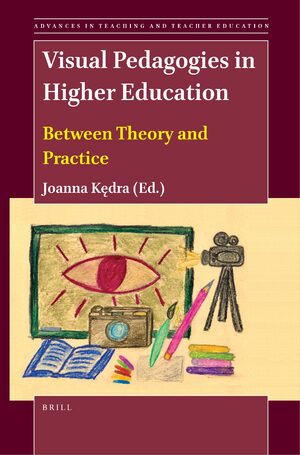
My edited book “Visual Pedagogies in Higher Education: Between Theory and Practice” is already in the production process! The publication date is set up for October/November 2022, so very soon. It has been a great learning process for me and I am grateful to all contributors who make it possible to open the topic of visual pedagogies from so many different perspectives.
And here comes the table of contents for this volume:
Introduction: Visual Pedagogies in Higher Education Joanna Kędra
Part I:
Visual Pedagogies in Research Methods Courses
Chapter 1
As Visual as Possible: The Pedagogy of Visual Research Methods in a Finnish University Joanna Kędra and Rasa Zakeviciute
Part II:
Visual Pedagogies in Business Studies
Chapter 2
How Drawing Enhances Learning for Business Students Iryna Molodecky
Chapter 3
The Use of Freehand Drawings as a Means of Teaching Research Methods in a Business School Gyuzel Gadelshina, Rob Wilson, Paul Richter and McKenzie Lloyd-Smith
Part III:
Visual Pedagogies and Object-Based Learning
Chapter 4
Discipline-led Thinking Through Cultural Collections and Art Olivia Meehan
Part IV:
Visual Pedagogies in Photography Education
Chapter 5
Photomedia Literacy in Ruins? Student Attitudes toward Digital and Analogue Photomedia when Creating an Archive for the Future Gary McLeod and Tad Hara
Chapter 6
Teaching Photography Theory to Art Students — Three Case Studies Marianna Michałowska
Part V:
Visual Pedagogies in Teacher Education
Chapter 7
Learner-Generated Video: Video Creation Process for Developing Visual Competencies Pınar Nuhoğlu Kibar
Chapter 8
Using Visual Art Practices to Enhance Educators’ Professional Growth Karen F. Tardrew
Concluding Note: Measuring Success in Visual Pedagogies Joanna Kędra
…for collaborative and diverse development of teaching and learning at the department.
I received this award in collaboration with my departmental colleague, Dr. Judit Hahn, with whom we have collaborate in recent year quite intensively on various initiatives related to teaching development. The award is granted by the Vice Rector of the University of Jyväskylä, Prof. Marja-Leena Laakso, upon recommendations from the Educational Council of the university (more on the award: here).
Everything started one day in the coffee/break room in our department… We haven’t yet known each other with Judit as I joint (back) my department after two years since I completed my PhD. During this time, the unit has grown as a result of merge of two departments, these of communication and languages. So, yes… the coffee-room… we got to know each other by simply complaining on a lack of equal treatment in university policy (and thus also on department’s and faculty’s levels) the two main activities, that is, ‘research’ and ‘teaching’. Those who succeeded in research received recognition, but small and big achievements in teaching practice remain silent. As a consequence, raising an issue to develop quality of teaching in the department (or university) seems not be a popular activity or topic for discussion.
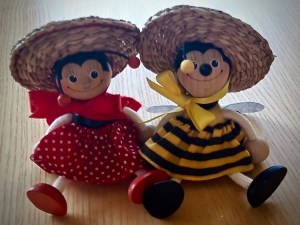
Me and Judit, with the Teachers’ Chat Room’s mascots, after receiving the award.
I am not experienced teacher, but Judit is. I do not have much opportunities to teach, so I research topics related to university pedagogy and teaching practices, especially in a context of visual education. As a team, we introduced the Teachers’ Chat Room (TCR), a space and a time for all members of the Language Campus/Department who are involved, or interested in teaching to share their ideas, good practices, excitement, frustrations, accomplishments, and questions related to teaching and education. The TCR is a place for both junior and senior members of the university community interested, or involved in teaching. During the TCR meetings we have opened up the following topics:
the first lesson: lesson planning, icebreakers, tips and tools for a good start;
digital tools in teaching;
object-based learning and visual literacy (guest: Dr. Olivia Meehan, Melbourne University, Australia);
trial lecture: preparation, performance and evaluation (forthcoming TCR);
The main idea behind the TCR is to create an informal meeting-place for sharing, peer-support and learning from each other. Thus, to develop university teaching and pedagogy in a community spirit.
We are also involved in few more initiatives related to teaching development (e.g. The First Year Experience development group; making teaching visible on department’s website; extensive publishing on topics related to pedagogy), hoping that in the future, teaching, and thus, excellence in teaching will receive more recognition. I also hope that in the future, faculty members receiving this and similar awards will hear ‘congratulations-words’ from the heads of their units as they would have heard if this would be an award for the research merits…
I learnt a lot. I made some mistakes that now I know could have been avoided if I would have had at least some editorial experience that I have now, when the process is over. Nevertheless, I am very proud that we both, i.e. me and my friend and colleague, Rasa Zakeviciute, made it to this point. Editing this (double) special issue of the “Journal of Visual Literacy” was a true adventure. Starting with issues with the Editorial Manager that we tried to solve when we both were on holidays in different countries; including looking for reviewers across academic context (and thus getting to know when they all have holidays); up to hours of editorial meetings along with long evening phone-calls trying to solve disciplinary disagreements between communication studies (me) and social sciences (Rasa) paradigms.
At the same time we experienced a lot of academic freedom in the editing process from Maria Avgerinou, editor-in-chief of the journal. We did not simply put the papers together, but we really worked with each single contributor to make this special issue happen. Thus, we acted both as guest editors as well as reviewers (in addition to the double blind peer-review process). You can enjoy an extensive introduction to this special issue in the Editorial, just being published ahead of print.
In order to read all eleven contributions, we still have to wait before they appear online, but here is the list of what you should look forward to:
Asko Lehmuskallio. The look as a medium: A conceptual framework and an exercise for teaching visual studies.
Gary McLeod. Rephotography for Photographers: discussing methodological compromises by post-graduate online learners of photography.
Terry Loerts and Christina Belcher. Developing visual literacy competencies while learning course content through visual journaling: teacher candidate perspectives.
Wendy R. Williams. Attending to the Visual Aspects of Visual Storytelling: Using Art and Design Concepts to Interpret and Compose Narratives with Images.
Jeeyoung Min. Visual literacies in a U.S. undergraduate writing course: A case study of transmediation.
Suriati Abas. Reading the world – Teaching visual analysis in higher education
Dana Statton Thompson. Teaching students to critically read digital images: A visual literacy approach using the DIG Method.
Choon-Lee Chai. Enhancing Visual Literacy of Students through Photo Elicitation.
Vered Heruti. Reading Personal Photographs: A Case Study at an Israeli Art College on Multiple Identities.
Gyuzel Gadelshina. Arrian Cornwell and David Spoors. Understanding corruption through freehand drawings: a case study of undergraduate business students’ visual learning in the classroom.
Rosalina Costa. iPhone, iResearch. Exploring the Use of Smart Phones in the Teaching and Learning of Visual Qualitative Methodologies.
I would like to share a couple of thoughts about my teaching philosophy. These reflections were in fact a part of the outcome of the university pedagogy programme TACE – Teaching Academic Content through English, in which I took part from March 2012 to March 2013 at the University of Jyväskylä.

 I received this award in collaboration with my departmental colleague, Dr. Judit Hahn, with whom we have collaborate in recent year quite intensively on various initiatives related to teaching development. The award is granted by the Vice Rector of the University of Jyväskylä, Prof. Marja-Leena Laakso, upon recommendations from the Educational Council of the university (more on the award: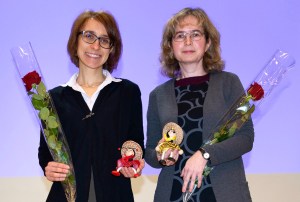
 Joanna Łucja Kędra