Uncategorized

To All My Students

I want you to know that I always look forward to meeting you in my classroom and hearing your comments, answering your questions, and sharing your experiences. I learn so that you can learn from me – but I also learn from you. This is about sharing what each of us knows and does not yet know. I spend many hours preparing materials for the class. But sometimes I worry that some things could have been done better. And so I try to improve the materials, the content, the assignments for next time. But even when I worry that my course or a particular lecture, seminar, or assignment was not good enough – I hear from you, in the feedback or after class, that you really enjoyed the course and learned a lot. Thank you for that.

I want you to know that the best reward I get for all the effort I put into teaching is when you come up to me after class and say that this was the best class you have ever taken; that you want more of these classes; that you loved all the topics and that you learned a lot and that this course made you think differently. Then I know it was all worth it!

Uncategorized

“Visual Pedagogies” book launch summary

Both events of the online book launch of “Visual Pedagogies in Higher Education: Between Theory and Practice” were a great opportunity to share the work included in the volume. It was wonderful to see many colleagues attending these events, asking questions and discussing. I was happy to see those of you who I know and have been collaborating with on various occasions, and many persons who I did not know before but who were intrigued by the work related to visual pedagogies. Let’s the ideas around visual pedagogies continue to evolve into new and further collaborations!

A visual summary of both events was captured visually by Iryna Molodecky, one of the contributors to the volume. She kindly agreed for this image to be shared here. In case you want to know more about her work, check Iryna’s website (of course, in addition to her chapter in “Visual Pedagogies”).
Uncategorized

“Visual Pedagogies” Book Launch

Come and get inspired by the ideas on how to implement elements of visual pedagogies in university education

Two events, on November 16th and 22nd, are organized to launch newly published book “Visual Pedagogies in Higher Education: Between Theory and Practice” which I edited. Each event will start with a short overview of the book (by me) and will follow by the introductions to four chapters (by the contributors). There will be time for questions, exchange of ideas and discussion.

You are welcome to attend both events or to choose one, based on your schedule and interest. Sign up HERE to get the Zoom link.

On 16th November at 2:00 – 3:00pm (EET / UTC+2) we will hear introductions to the following chapters:

  • As Visual as Possible: The Pedagogy of Visual Research Methods in a Finnish University (by Joanna Kędra and Rasa Žakevičiūtė)
  • Discipline-Led Thinking through Cultural Collections and Art (by Olivia Meehan)
  • Photomedia Literacy in Ruins? Student Attitudes toward Digital and Analog Photomedia When Creating an Archive for the Future (by Gary McLeod and Tad Hara)
  • Learner-Generated Video: Video Creation Process for Developing Visual Competencies (by Pınar Nuhoğlu Kibar)

On 22nd November at 3:00 – 4:00pm (EET / UTC+2) we will hear introductions to the following chapters:

  • Teaching Photography Theory to Art Students: Three Case Studies (by Marianna Michałowska)
  • Using Visual Art Practices to Enhance Educators’ Professional Growth (by Karen F. Tardrew)
  • How Drawing Enhances Learning for Business Students (by Iryna Molodecky)
  • The Use of Freehand Drawing as a Means of Teaching Research Methods in a Business School (by Gyuzel Gadelshina)
Uncategorized

Book: Visual Pedagogies in Higher Education

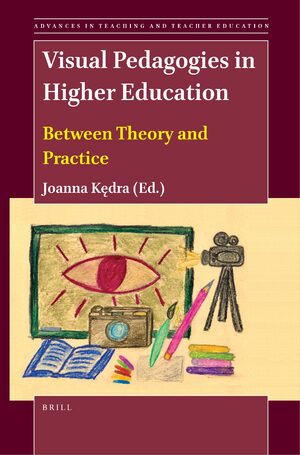
My edited book “Visual Pedagogies in Higher Education: Between Theory and Practice” is already in the production process! The publication date is set up for October/November 2022, so very soon. It has been a great learning process for me and I am grateful to all contributors who make it possible to open the topic of visual pedagogies from so many different perspectives.

And here comes the table of contents for this volume:

Introduction: Visual Pedagogies in Higher Education
Joanna Kędra
Part I:Visual Pedagogies in Research Methods Courses
Chapter 1As Visual as Possible: The Pedagogy of Visual Research Methods in a Finnish University
Joanna Kędra and Rasa Zakeviciute
Part II:Visual Pedagogies in Business Studies
Chapter 2How Drawing Enhances Learning for Business Students
Iryna Molodecky
Chapter 3The Use of Freehand Drawings as a Means of Teaching Research Methods in a Business School
Gyuzel Gadelshina, Rob Wilson, Paul Richter and McKenzie Lloyd-Smith
Part III:Visual Pedagogies and Object-Based Learning
Chapter 4Discipline-led Thinking Through Cultural Collections and Art
Olivia Meehan
Part IV:Visual Pedagogies in Photography Education
Chapter 5Photomedia Literacy in Ruins? Student Attitudes toward Digital and Analogue Photomedia when Creating an Archive for the Future
Gary McLeod and Tad Hara
Chapter 6Teaching Photography Theory to Art Students — Three Case Studies
Marianna Michałowska
Part V:Visual Pedagogies in Teacher Education
Chapter 7Learner-Generated Video: Video Creation Process for Developing Visual Competencies
Pınar Nuhoğlu Kibar
Chapter 8Using Visual Art Practices to Enhance Educators’ Professional Growth
Karen F. Tardrew
Concluding Note: Measuring Success in Visual Pedagogies
Joanna Kędra
Uncategorized

Special issue editorial: “Visual literacy practices in higher education”

I learnt a lot. I made some mistakes that now I know could have been avoided if I would have had at least some editorial experience that I have now, when the process is over. Nevertheless, I am very proud that we both, i.e. me and my friend and colleague, Rasa Zakeviciute, made it to this point. Editing this (double) special issue of the “Journal of Visual Literacy” was a true adventure. Starting with issues with the Editorial Manager that we tried to solve when we both were on holidays in different countries; including looking for reviewers across academic context (and thus getting to know when they all have holidays); up to hours of editorial meetings along with long evening phone-calls trying to solve disciplinary disagreements between communication studies (me) and social sciences (Rasa) paradigms.

At the same time we experienced a lot of academic freedom in the editing process from Maria Avgerinou, editor-in-chief of the journal. We did not simply put the papers together, but we really worked with each single contributor to make this special issue happen. Thus, we acted both as guest editors as well as reviewers (in addition to the double blind peer-review process). You can enjoy an extensive introduction to this special issue in the Editorial, just being published ahead of print.

In order to read all eleven contributions, we still have to wait before they appear online, but here is the list of what you should look forward to:

  1. Asko Lehmuskallio. The look as a medium: A conceptual framework and an exercise for teaching visual studies.
  2. Gary McLeod. Rephotography for Photographers: discussing methodological compromises by post-graduate online learners of photography.
  3. Terry Loerts and Christina Belcher. Developing visual literacy competencies while learning course content through visual journaling: teacher candidate perspectives.
  4. Wendy R. Williams. Attending to the Visual Aspects of Visual Storytelling: Using Art and Design Concepts to Interpret and Compose Narratives with Images.
  5. Jeeyoung Min. Visual literacies in a U.S. undergraduate writing course: A case study of transmediation.
  6. Suriati Abas. Reading the world – Teaching visual analysis in higher education
  7. Dana Statton Thompson. Teaching students to critically read digital images: A visual literacy approach using the DIG Method.
  8. Choon-Lee Chai. Enhancing Visual Literacy of Students through Photo Elicitation.
  9. Vered Heruti. Reading Personal Photographs: A Case Study at an Israeli Art College on Multiple Identities.
  10. Gyuzel Gadelshina. Arrian Cornwell and David Spoors. Understanding corruption through freehand drawings: a case study of undergraduate business students’ visual learning in the classroom.
  11. Rosalina Costa. iPhone, iResearch. Exploring the Use of Smart Phones in the Teaching and Learning of Visual Qualitative Methodologies.
Uncategorized

What does it mean to be visually literate?

We should close the debate over the concept of visual literacy and do something about its implementation in education. I draw this conclusion by actually coming back to the roots of visual literacy movement and Fransecky and Debes’s (1972, p. 5) call: ‘If you really want to understand visual literacy, you will have to do something about it’.

In my recently published article: “What does it mean to be visually literate? Examination of visual literacy definitions in a context of higher education”, I intended to avoid either compiling a corpus of visual literacy definitions or advancing its theory. Instead, I selected several visual literacy definitions that can be useful for education practitioners, particularly within university education. The selection includes both the more established as well as some recent definitions. I further aimed to translate them into concrete learning and teaching objectives. As a result, I constructed lists of skills (abilities, competencies) that a visually literate individual should be able to demonstrate.

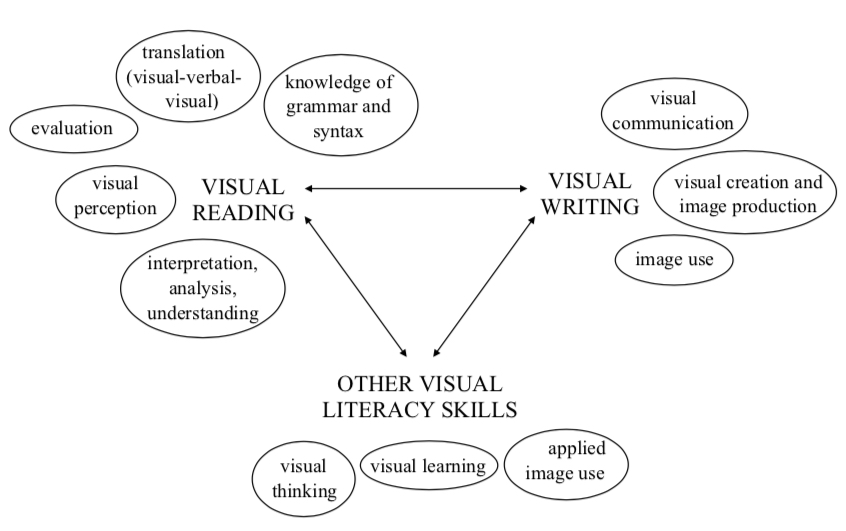
The figure below shows three categories of visual literacy skills with thematic groups of skills, based on the review of eleven visual literacy definitions published between 1969 and 2013.

Figure_VL skills


rjvl

Uncategorized

CFP: Developing visual pedagogies in university classrooms: What, why and how? (Journal of Visual Literacy)

With this special issue we attempt to fill the gap by encouraging prospective authors to reflect on visually oriented teaching practices in university classrooms. We want to compile this special issue along the argument that visual literacy should be the basic educational requirement for both undergraduate and graduate students. Therefore, we welcome theoretical, and foremost, practical papers on visual education in university classrooms. Being aware of the palette of various definitions applied, we understand visual literacy as a group of abilities (skills or competencies) in visual reading (interpreting or meaning making), writing (creating or using visuals), and visual thinking. As such, submissions across disciplines are welcome.

Types of submissions:

  1. full theoretical or empirical papers discussing the need for visual literacy, visual education and relevant visual pedagogies in university education, or
  2. innovative teaching ideas intended for university classroom that employ visuals of any kind or form and which have a potential to develop students’ visual literacy skills.

This call for papers is open until 30th June 2018, the special issue is expected to be published by the end of 2018. Please address questions, inquiries and letters of intent to the editors of this special issue.

Full text call and guidelines: Journal of Visual Literacy special issue CFP

Special issue editors:

Joanna Kędra, PhD, Postdoctoral Researcher in the Finnish Institute for Educational Research, University of Jyväskylä, Finland, joanna.kedra[at]jyu.fi

Rasa Žakevičiūtė, Doctoral Researcher in the Department of Social Sciences and Philosophy, University of Jyväskylä, Finland, rasa.zakeviciute[at]jyu.fi