Uncategorized

Teaching: Intensive but Rewarding

I don’t know what’s about September, but it’s always so intense in terms of all possible work tasks. One year this is about founding application, the other year it’s about conferencing, and then yet another one is about teaching. This year it started already on September 1st, with a session on “What is… visual research?” collaboratively organized with Dr. Mélodine Sommier at the Methods Festival at the University of Jyväskylä.

Following, I was teaching an intensive doctoral course on Visual Research Methods and Methodologies at the same university. This was a new course, which I wanted to introduce already a while ago as I noticed a clear need for it over the years I worked at this university. We had four very intensive Tuesdays (20 teaching hours in total), during which we discussed our ways of seeing and interpreting visual imagery, methods to analyze found images, and participatory visual techniques. As always, I was worried if it was “enough” and how well it helped and guided participants toward their future endeavours with visual research. I was worried to the extend that I did not ask for the course feedback. And here it came, some wonderful comments from the participants, spontaneously sent to me by the participants:

Thank you again for the course – what an absolute delight it was! My mind is buzzing with ideas for future research.

I must thank you for the inspiring, clear, intellectual building blocks giving course of research. The group and the lecturer (i.e. you) empowered me enormously.

And I’m also continuing my Friday teaching trips to Tampere University to teach a course on Visual Cultures and Technologies. This year, in addition to challenges of the hybrid format, I’m also having a larger group of 34 students in the course. I’m still trying to devote as much as possible time for questions, discussions and group activities, and I’m so much looking forward to students’ visual case studies they will introduce in the second part of the course.

So, yes, September… or, well, it’s October already!
Uncategorized

Visual prompts and visual methods in multilingualism research

A real eye opener to practiced-based visual research methods, variety of approaches and innovative ideas – a 3-day workshop “Visual prompts and visual methods in multilingualism research”, organized by the MultiLing Research Center at the University of Oslo, Norway, that took place 17-19 June 2019 (and that I was lucky to participate in).

I must confess to my initial skepticism regarding the content and context of this event: visual research methods and language studies brought together… I know, of course, that visual methods are multidisciplinary. However, my initial encounter with VRM scholarship within the discipline of linguistics raised many questions and doubts. These mainly concerned an issue if the methods applied and referred to are, actually, visual research methods (in a way I used to know them). In this context, the Oslo workshop truly enriched my knowledge about VRM. It also demonstrated that VRM can be, indeed, applied across disciplines.

The paper that I found particularly interesting and “absolutely visual” in approach was a study of sign language in a form of auto-driven visual elicitation. Maartje De Meulder and Annelies Kusters used a well-known (in language studies) method of a language portrait (a method that I would have questioned the most, based on my initial readings). However, examples of data that they showed were very reach, with a variety of participants’ approach to the idea of “drawing the language”. In addition, and as a common practice in sign language research, they presented extracts from video interviews. Here, participants could really explain and present their relationship with language(s). I was truly surprised by how the language can be embodied – that was both showed in the drawings of language portrait and in the video interviews.

In addition to many interesting papers, I was also positively surprised by a new format of a material session. It can be understood as a more relaxed and even more engaging variation of a traditional poster session. In this case, presenters were introducing their cases, or actually the methods they applied, in a form of a variety of materials they could have brought to the table (so there was no actual posters, but table-spots with a scholar you could approach for further explanation of her/his research).

In addition to the regular paper, I was also presenting my auto-driven elicitation method of an interactive collage in the material session. A method of an interactive collage, I have recently applied in the fieldwork with Polish-speaking families living in Finland (as part of the ‘WhatsInApp’ project). And again – I was positively surprised by a high interest in both the method and my project. I came to this workshop as a sort of “outsider”, visual scholar with a background in communication studies. I thought I will not be able to find a common language (sic!) with language scholars. And it turned out to be the opposite – actually, here, I finally talked to researchers who are very practice-oriented. They also really kept the focus on visual methods, which I could not always observe with my visual cultures/studies colleagues on some other occasions. At the “Visual prompts” workshop there were, of course, some papers and discussions that I was not able to follow and engage in, having no background in linguistics. Nevertheless, these three days were very refreshing and particularly important in bringing new ideas and motivation for my further fieldwork in the ‘WhatsInApp’ project.

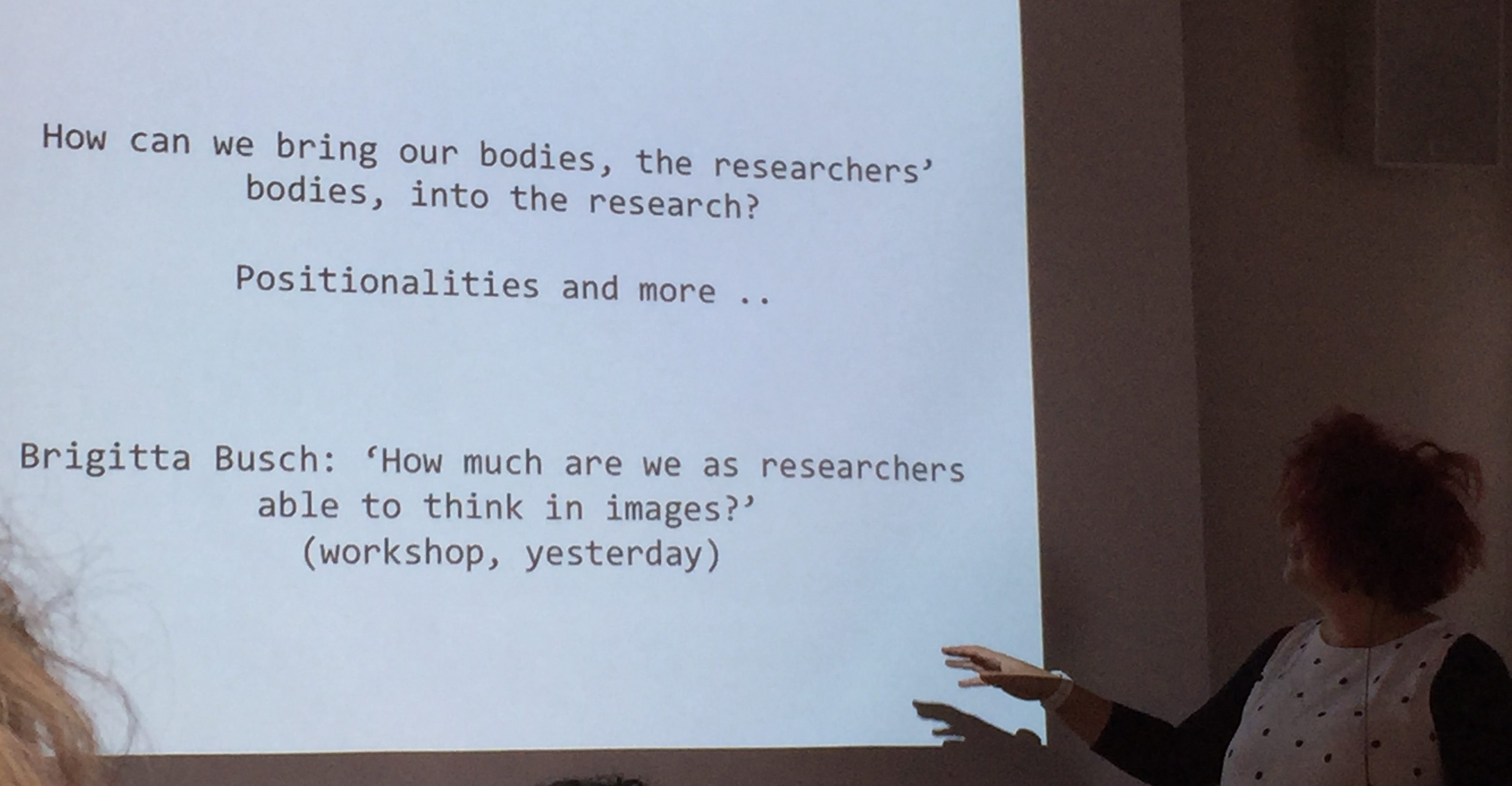
Workshop summary with a focus on researcher position in the research process (in a fieldwork) and in relation to images.

Uncategorized

Why Visuals Matter? Using Images as Data

On 30th of May, during the two-day Methods Festival (30-31.05.2017) at the University of Jyväskylä I organized the seesion Why Visuals Matter? Using Images as Data.

By organizing this session, I aimed to create a space to discuss the importance of using visuals and visual research methods in contemporary scholarship. Visual research methods are those that incorporate some kind of imagery into the research process. Images can be used as data or as a tool through which data is analyzed or collected, or finally disseminated. Using visual research methods has recently become even fashionable in some way (just to mention be-annual Conference on Visual Methods, or the so-called post-disciplinary journal Visual Methodologies, and a number of recently published handbooks). Thus, the session aimed to get closer to the question Why Visuals Matter?

The session was possible thanks to my three colleagues that presented their approaches to working with images or using visual research methods. I am really greatful for their input and interesting discussion that followed, including really a lot of questions from the audience!

Presenters within the session:

  • Asko Lehmuskallio, Senior University Researcher, Docent, University of Tampere, Chair ECREA TWG Visual Cultures. Title of his presentation: It’s not about the looks, but about the look.
  • Jenni Mäenpää, University of Tampere, postdoc researcher. Title of her presentation: Photographs as research tools in studying photo-journalistic work practices.
  • Mari Pienimäki, University of Tampere, postdoc researcher. Title of her presentation: Informant generated photographs as research data.

I am always very happy when events like this can take place, esepcially when visual studies get its place within broader streem of research. It is also very encouraging seeing such interest in the image-based research among the audience. I think that there is an urgent need to bring together scholars within Finnish academia to discuss their appraoches and experience in visual methodologies.